
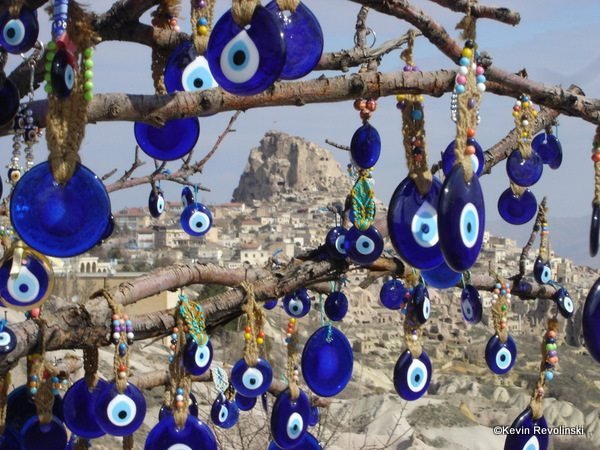
Evil Eye Protection in Turkey

When I first moved to Turkey, I was having dinner with my friend İffet. After the meal we ordered some Turkish coffee. Our drinks came out strong and gritty and in small shot-sized cups. A lot of Turks can spend a good ten minutes telling fortunes from the silt at the bottom of the cup, and Iffet is a pro. I covered my cup with its saucers and flipped it over. My fortune included five long journeys, a tall, thin woman, an elephant, and no tears. To this day I’m really not sure what that meant. But the combination of modernity and ancient traditions is something that has always charmed me about Turkey.
Hanging on the wall of the restaurant was a round blue glass about the size of the palm of my hand with a dark circle within a light blue circle within a white circle on it. I had seen so many of them before in varying sizes. They were common in shops and markets either for sale or hanging as decoration. Taxi drivers had small ones dangling from their rearview mirrors or key chains.
“İffet, what is that?”
She smiled, “That is nazar boncuğu; it protects you from the evil eye.”
I raised my eyebrows. “Does it work?” I winked at the superstition.
“People do not completely believe it, but just hope that it might protect them. But most people including me believe that jealous eyes always bring bad luck, and people have lots of stories that could prove this belief. We do other things to get rid of the evil eye. Some melt lead and pour it into cold water over the head of a person in order to break an evil spell, some break something made of glass, and some carry a prayer called ‘muska’ written by a hoca, a religious teacher.” (In fact, my students used to sometimes call me hoca.)
The evil eye? I thought. Was this the stuff of cartoons and spooky movies? No, in fact the history of the evil eye goes back far before the Turks’ arrival in the Middle East in the 11th century. Worldwide it seems nearly every culture has a reference to it. Certainly all across the Mediterranean and Middle East there is a dominant belief in the curse. There are several references in the Bible, but the most ancient record of the evil eye is as far back as 3000 B.C. in the cuneiform texts of the Sumerians.
 The Greeks painted eyes on the prows of their seagoing vessels to protect them from misfortune. But perhaps one of the most obvious examples of a society obsessed with the power of the eyes is Ancient Egypt. The Egyptians used cosmetics such as the dark powder kohl to outline the eyes to prevent the evil from entering them, and drawings of eyes were used as protection in tombs and on death shrouds.
In his 1895 work The Evil Eye, English author Frederick Thomas Elworthy admits “the origin of the belief is lost in the obscurity of prehistoric ages. The enlightened call it superstition; but it holds sway over the people of many countries… and must be set down as one of the hereditary and instinctive convictions of mankind.” Cave people casting hexes with a wonky eye?
But though a look can bring evil, it isn’t necessarily the village witch casting a spell or someone purposely making trouble. Consider this Turkish story:
There was once a village by the sea where there was found along the shore a massive rock that no one could move or break apart. One of the villagers was known to have the evil eye and when he came down to the sea and had a look at the rock, he commented with awe at its impossible size. As soon as he spoke, the giant rock split in two with a thundering crack. Now when things go badly, when a prized possession disappears, when a newborn baby becomes sick—or worse, when someone dies unexpectedly—it is said that “nazar” has touched him or her. The Turkish word “nazar” comes from Arabic for “eye” or “look.”
 In fact, in Turkey most people fear it as an inadvertent ill-effect caused by envy. The word envy itself derives from the Latin invidere, which means to look at askance or closely. Sometimes known in certain cultures as “overlooking,” it could mean simply gazing too long at someone’s children, pets, or trusty donkey with admiration. Many believe the risk of the evil eye is most prevalent when things are going great. Too much good fortune? Something’s bound to go wrong. Call me paranoid and a pessimist, but I myself often get a little nervous when everything seems to be going my way. It may be construed as a twisted form of humility, but you don’t jinx good fortune by pointing it out.
But what to do if you do have a cute kid or a cow that gives a lot of milk? Cures against the effects of the evil eye are about as ancient and abundant as the curses themselves. Spitting was believed by the Greeks and Romans to be an effective measure. Fortunately the Turks adopted the less disgusting and most common defense against the evil eye: the amulet.
In their case this is the evil eye bead or nazar boncuğu (nah-ZAHR bohn-ju-u). It’s a form of fighting fire with fire, an eye for an evil eye. Often wrongly translated to English as the evil eye itself, it is actually a “benevolent eye” fending off the evil one. Its purpose is to reflect the dark powers of an envious glance. The amulet is typically round and made of glass fashioned with blue and white concentric circles made to look like a wide open eye. The color blue is believed to ward off bad luck which is why the blue front doors are common in the Greek Isles for example. And if a nazar boncuğu ever cracks or shatters, this means it has just absorbed a rather powerful bit of the evil eye. It should be replaced immediately!

Evil eye beads come in all shapes and sizes: pendants, earrings, key chains, wall hangings, pins, shot glasses, ash trays—I’ve seen them all. Bracelets often have a whole series of tiny glass evil eye beads worked into them. Sometimes the amulets are worked into the foundations of new buildings. Most homes and shops have one displayed somewhere, and though many Turks may shrug it off with a smile, there aren’t too many cribs of newborn babies that don’t have one of the protective blue eyes displayed. Mothers will attach a small bead on a safety pin to a child’s clothes or diaper. Why take any chances, right?
The best of the evil eye beads are made by artisans following a longstanding tradition of glassmaking in the Middle East. Arabs brought the practice to Izmir on the Aegean coast in the 19th century and brought back the popularity of a practice that once flourished in Anatolia, the central high plain of modern Turkey. The smoke and fire hazard of the ovens forced glassmakers to smaller villages. Today the bead makers of Görece and Kurudere claim to be the only ones making the “real” nazar boncuğu. They add a bit of yellow to the eyes using an oxide in the glassmaking process that remains a sort of secret recipe.
So where can you get one? Tourist shops carry them, streetside vendors may peddle them, and in the Grand Bazaar you can find whole shops dedicated to the nazar boncuğu. They make great gifts, if only for the story of them, and honestly, do you really want to risk falling victim to the evil eye?
___________________________________________________________
For more about what I learned in Turkey, check out my book The Yogurt Man Cometh. If you would like an autographed copy, skip Amazon and contact me directly!





 ORDER YOUR COPY TODAY!
 ORDER YOUR COPY TODAY!
In Japan, too, an abudance of good luck requires payment: If a golfer hits a hole in one, they owe their companions a round of drinks. Too much good luck can be expensive!
It’s sort of a don’t get uppity rule. 🙂
Pingback: Turkish Coffee: Its Past and Your Future
Just wanted to let you know that the “evil eye” is still a hotly debated topic … the Turks think it’s their tradition – the Greeks firmly believe it is there’s and that it dates back to the ancient Greeks…. or so my Greek husband and relatives tell me. Just wanted to share. 😉
By the tradition do you mean the glass icon or just the concept? I’d imagine the Turks picked it up when they came down from Asia into Anatolia in the 11th century. The Egyptians were big on eye symbols and you can see it on boats in various Mediterranean places such as Malta. So the concept itself I think may even predate the Greeks. However, I am not sure who first made the glass. 🙂 Is your husband like the dad in My Big Fat Greek Wedding? “Give me any word, and I show you how the root is Greek!” 😉 It’s a fascinating part of the world. Thanks for reading!
Pingback: Photo Gallery: Cappadocia, Turkey
I find the Greeks funny as they claim everything is theirs.. Even Turkish coffee they call Greek coffee.. But wait… The funniest it they pretend Turkish delight is Greek also and call it Greek delight..
Wait… There is more… Doner kebab is also apparently “Greek” lol actually doner means turning in Turkish. Also dolmadis is supposed to be Greek.. Stuffed leaves. Actually again dolma in Turkish means to stuff..
I wonder if the Greeks invented being broke? lol
Empire envy. 🙂
Actually Arabic coffee was invented first, so by the time it came to Turkey, it was just changed a bit and called Turkish coffee.Turkish delight was invented by the Persians and Turks sold the recipe.There is evidence of gummy, syrupy sweets dating back to the 9th century in Persia.The recipe is repeated on manuscripts pre-dating Hadji Bekir (Turk inventor) by half-a-millennia in Persia. Dolma was invented in Armenia 2000 years ago the Turks copied the recipe. The word Dolma, which is pronounced tolma in Armenia, is borrowed from the Urartian word for grape vine, toli, which would make dolma a derivative of tolma which in turn comes from toil.
This is a misleading Orientalistic look which is being used over and over for centuries while trying to understand Turkey’s complex history and culture. What all you mentioned is Anatolia’s history, since all people you mentioned existed in Anatolia. You cannot seperate Anatolia’s culture as Greeks, Armenians, Turks, Persians and so on. These are all Anatolian people who blended with eachother in thousand years and developed many things and surely the culture as well.
Hey guys, my gf got an evil eye key chain as a gift from turkey from a blue eyed friend. Since having it we haven’t been able to sleep at night just keep waking up and having strange dreams/nightmares , we can’t think of anything else thatay be causing it . any thoughts?
she has been cursed with a demon from the other world! – jkn 😀
its supposed to fight off the evil eye so i dont think it has to do with your gf dreams or such.
The Nazar Boncuk charm (or Evil Eye Bead) is an “eye”, often set on a blue background. It stares back at the world to ward off the evil spirits and keep you safe from harm
Since then the people have been attaching this evil eye bead to everything they wished to protect from the evil eyes. From the new-born babies to their horses or even to the doors of their homes…
This tradition still lives in Turkey. The glimmering evil eye beads that are hand made with ancient methods by a very few glass masters, are distributed from Anatolia to the whole world.
Visit my documentary site : http://www.nazarboncugu.com to read more and see pictures from old bead furnaces in Turkey
I am in Turkey at the moment and have seen this evil eye everywhere. I remember seeing it in Greece years ago, I thought I would google it and hence got here.
In Islam the evil eye is something very true, it is caused by someone having envy on someone. We say Mash’Allaah when we see something nice to protect from evil eye and I think the Greeks do to. The protection from evil eye comes from God, hence to have a charm protecting you from it is a very big sin in Islam in fact the biggest sin, as only God can protect from it and not an amulet. However many Muslims wear or use some form of protection from the evil eye. In Turkey it is the evil eye, in Pakistan and India they where some verses of the Quran wrapped in cloth or metal round there neck.
One piece of my evil eye keychain fell off should I replaced it immediately it’s from Turkey from an x coworker help
Is the evil eye icon still intact? Then you are fine. If it is broken, it has protected you from the evil eye and you need to replace it. 😉